
Learn the ins and outs of creating a film budget. It leads to less stress and more success. This article shares key points for a successful film production budget.

Source: RDNE Stock project
Budgeting is an integral part of becoming a successful filmmaker. Developing a budget for your film requires you to forecast the costs of producing the movie—the more complex the project, the more specific details you need to set within the budget. In a nutshell, the film’s budget is your guidebook. Your success is based on how well you can follow your budget and prevent production costs from escalating. The budget is simply a guidebook that controls costs and safeguards the money needed to produce and bring the film to the silver screen.
The budget is all about listing every expense involved in making the film before production. The filmmaker can create a complete and thorough budget after breaking down a script and organizing a production board. The filmmaker working with the line producer does the task, which saves the producers a lot of heartache.
The budget is based on the screenplay you choose to produce. A story with few characters and locations in your hometown is cheaper than one with many characters and locations worldwide. Developing a sound budget depends on how well the script is broken down in terms of cost.
Example of Budgeting a Film Script
For example, a screenplay may appear simple with only one, two or three characters, yet it may include a scene that describes:
53. EXT – FARM – NIGHT
Flashes of lightning cover the night sky. Three Horses race out of the barn as lightning strikes the giant oak tree. Helen comes out of the farmhouse to face the burning tree and watch the horses run off.
Even though the “flashes of lightning cover the night sky” and “Three Horses race out of the barn as lightning strikes the large oak tree” offer stimulating visuals, they could cost hundreds of thousands of dollars to create. Filmmakers may need to rewrite a dramatic scene to fit a smaller budget.
53. EXT – FARM – NIGHT
Flashes of lightning light up the farmhouse. Horses squeal and roar from the barn as Helen hears lightning strike the giant oak tree. Helen comes out of the farmhouse to face the burning tree. She crosses to the barn and sees the empty stalls. The horses have run off.
Going with the first attempt would have resulted in higher costs. The creation of lightning, horses racing out, and lightning strikes on the giant oak tree would have required additional crew, a special effects coordinator, and computer-generated imagery. The second attempt keeps the storyline with flashes of lightning on the house, not in the sky. The burning oak tree can easily be a prop in the dark. Hearing the horses and Helen seeing that they had run off doesn’t require horses. A creative filmmaker can keep the budget down as long as the storyline moves forward. In other words, more money spent on a film means more problems to solve.

Source: Fillm Proposals
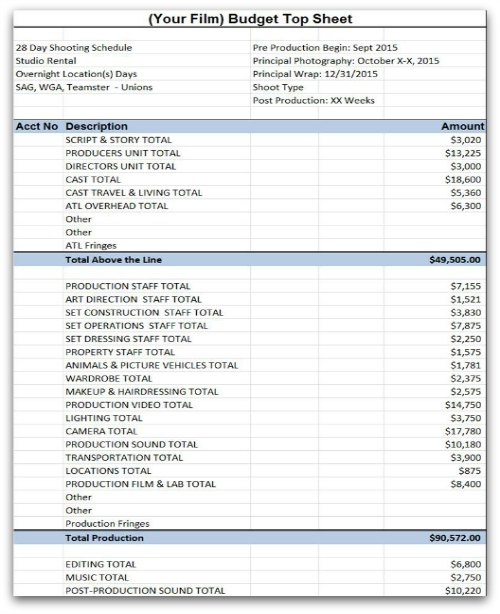
Budget Top Sheet Organizes Expenses
Filmmakers work off a Budget Top Sheet. It provides a summary of how the money is allocated during the filmmaking process.
At the top of the top sheet is the general information used in forming the budget. The names of the producer and director are listed at the top because they are responsible for overseeing the overall budget. Other information given is the start date and completion date of the production. It is imperative to understand the top sheet, as any changes to it will affect the entire budget dynamic. The top sheet will inevitably change because the production stage of a film is the most liable aspect of the process. Unknown factors, such as location, weather, actors, stunt performers, and production issues, can cause liability.
Above-The-Line vs Below-The-Line Costs
Two distinct divisions separate the budget: above-the-line and below-the-line. Based on the early days of Hollywood, the positions above the line were the more important creative elements in the production, such as screenwriters, producers, directors, and actors. Any costs relating to these categories were above the line. The below-the-line division is subdivided into the production period, the editing period, and miscellaneous overhead expenses associated with the entire production process. Obviously, a production designer, an art director, a cinematographer, a sound designer, a composer, an editor, and a costume designer are all important creative forces. Still, their costs fall below the line. It is a wise filmmaker who recognizes that everyone working on the production is an innovative resource because filmmaking is a collaborative process.

Source: Cottonbro Studio
Above-the-line production positions recognize the four guilds that classify certain creative personnel on a project: the Screen Actors Guild, the Directors Guild, the Producers Guild and the Writers Guild. We find all the rest of the union and federation members below the line.
Adding the above-the-line costs and the total below-the-line costs presents the direct cost for the whole production. Remember, this is not the final budget, as other unforeseen costs may arise. A contingency line is added to the top sheet for those unexpected elements. The contingency is predetermined as a percentage of the overall budget. Ideally, a 10 percent contingency fee should work. However, some productions have been as high as 30 – 40 percent. A contingency fee is the requirement for procuring a completion bond. Therefore, the direct cost, the contingency fee, and the completion bond make up the total cost for production. The top sheet of the budget also includes “other fees,” such as bank interest or other indirect costs that the filmmaker may not be aware of until after the budget is finalized.
What are Deferments in Film Production?
On the top sheet of the budget, you can include deferments. This is when the filmmaker determines that the available funds for the production are insufficient to cover the talent or services. The idea of deferred payment was introduced and developed in the 1970s. The advantage of deferred payment is that one doesn’t have the money or wherewithal to pay for the talent or services. As a result, they can pay them later. The disadvantage is that the talent or service can charge interest on the deferred payment, which will cost the production more money than if they had paid them upfront, and deferred payments are added to the negative cost. Then, the filmmaker will have a reputation for exceeding the production budget. Negative cost is the expense of producing a film. It excludes such costs as distribution and promotion. An example of a sound deferment is the Directors Guild allowing producers to hire its members based on the project’s budget. If the amount is less than $6 million, they pay 70 percent of the salary to the director, while the remaining 30 percent is deferred. In the bargain, they pay an additional 25 percent to the director for agreeing to the deferment.
The filmmaker should explore all options to keep the project within its budget while maintaining creativity. Yet, the producer pays attention to innovative suggestions that deviate from the original financial plan. It’s their job to help the project stay within its financial limits.
Although a budget is created for the overall production, it serves primarily as a guidebook for making decisions within the budget’s parameters. The budget must always stay within those parameters. If it does, the filmmaker must seek additional funding to complete the project.
As the project moves into production, it will take on a life of its own. You must safeguard your creative vision while avoiding getting lost in budget misfortunes. That is where the line producer comes in and manages the overall production flow.

The Indie Producers Handbook: Creative Producing from A to Z
This is my go-to book for film production. I recommend reading The “Indie Producer’s Handbook: Creative Producing from A to Z,” written by a film producer, Myrl A. Schreibman. It delivers a comprehensive and practical guide to running a film on a budget.