Category Archives: film careers

https://www.pexels.com/photo/man-in-black-and-white-long-sleeve-shirt-sitting-beside-woman-in-white-long-sleeve-shirt-7821915/

How to Become a Talent Agent

A talent agent recognizes what gets their client to the top of the A-list in their trade. Here’s how to become an agent.

Being an agent is a creative job dealing with creative people.
Source: Moose Photos

Do You Need a College Degree to Become a Talent Agent?

Skilled talent agents recognize talent and know what will put their clients at the top of their particular trades. In movies, we call this the A-list.

Being a talent agent is a demanding job for any newcomer to the film industry. This field requires knowledge of marketing, law, promotions, and public relations.

It would be best to have a college degree, at least an AA in marketing. Most successful talent agents hold a degree in business law.

A talent agent may represent various people with specific talents. The most common, of course, are actors, but others who work with talent agents include models, singers, musicians, directors, screenwriters, authors, and professional athletes.

“Being a star is an agent’s dream, not an actor’s.” Robert Duvall

Ari Gold in “Entourage”

Is Beind an Agent Like Ari Gold in Entourage?

Whether or not being a talent agent is like Ari Gold in Entourage, it is crucial to know that the entertainment business is all about the “business.”

If you want to be a talent agent, you need to be dedicated and willing to work hard and be a part of the business of making movies, taking in sports, or reading a lot of scripts. Whatever niche you pick, make sure you love it to death and are willing to support your clients for blood.

How Does a Talent Agency Work?

Talent agents usually pick a talent to work with and stick with that type throughout their careers. Many choose to work exclusively with children, professional athletes, or authors. Some work with television series actors, commercial actors or film actors, or high-profile celebrities.

The larger agencies create package deals with studios where they include the actor, screenwriter, and director clients in the same movie production deal.

The larger talent agencies provide training programs, called internships, for individuals interested in a career as a talent agent. At first, the agency requires the intern to do errands and paperwork; there’s very little to do with working directly with talent.

“I wish to be cremated. One-tenth of my ashes shall be given to my agent, as written in our contract.” Groucho Marx

As an agent, you’ll be part of the filming business.

Successful Talent Agents Learn the Rules

When you join a talent agency, it is very wise to learn the rules of the land. You need to find out the dos and don’ts of the group. You do not want to step on anyone’s toes or make a blunder that could cost the agency money and reputation.

When an agency hires you, you begin as an assistant. The agency assigns you to an experienced agent, and you help them with their clients. How long you are in that position depends on how hard you work and how well you get along with other people in the agency. If you have a speciality like law or public relations, you can move up relatively soon, within a year or two.

What Does a Talent Agent Do?

Here are the everyday tasks an agency does:

  • Meet with current or potential clients to find out what type of talent they need for their upcoming projects and make talent suggestions.
  • Promoting talent to different clients through networking and public relations is primary in setting up auditions and jobs.
  • Schedule or book appointments to attract talent. Regulations and appropriate working hours need to be adhered to by the agent and agency.
  • Market the talent agency itself to obtain more talent. Procuring talent is a very competitive aspect of an industry town. So, keep your wits about you.
  • Collect fees due upon booking of auditions or securing talent. Billing requires a 30-day cycle.
  • Arrange classes and workshops, such as voice, acting, and specialized training, so that the talent can advance in their craft.

Agencies Keep Track of Residuals

A friend of mine heard a commercial she starred in went regional, which should have meant more pay (residuals) for her as an actor. Without an agent, it would have been trying for her to prove the increase in residuals.

She contacted her agent and explained to him what had happened. He immediately called the company responsible and got her residuals plus penalty fees. The agent earned his 10% fee, as well.

An agency’s job is to keep track of its clients’ residuals. Clients should receive residuals each time a commercial, TV, or movie airs on a network, cable, or streaming outlet.

“Every time I try to retire or even think of retiring from acting, my agent comes up with a script.” Anthony Hopkins

Differences Between “Union” and “Non-Union” Towns

In “union towns,” union agencies are registered with the unions and follow the rules as established by the organization. Working for a union agency is the ideal way to go because everyone in the business is on the same page. Study the union rules on your own: the right way is the union way.

Non-union agencies are not regulated, so they operate under different rules than union agencies. They can throw you a curve and present you with unexpected situations.

Your options are limited when looking for work as a talent agent in a non-union or non-industry town. Try locating and listing the agencies within a 100-mile radius. Meet with each owner or manager and explore how you can assist the agency. Ask to intern for three months and then be considered for a permanent position.

Is Being a Talent Agent for You?

I don’t think being an agent is a cushy job. It takes hard work and dedication to work with the talent you support to the core. It’s also a people-person job that requires handholding and knowing when to offer sound advice to your client.

Kids Modeling and Acting Jobs

Winston and Khan

Modeling for Babies, Toddlers, and Children

A baby and teen modeling career requires certain factors besides your child being the cutest thing you have ever seen. This article explains how to get your kid into modeling and acting.

Are you sure your baby or child is photogenic and has the most beautiful smile, but are they willing and excited about modeling?

If not, don’t encourage them until they are enthusiastic about the modeling business. You have to be ready, too.

You will take time out of your schedule to take your child to agencies to meet potential clients. As long as you can handle dragging yourselves to and fro, you and the child will reap the rewards of a successful career.

Full-Time Job

Parents with full-time jobs can’t develop a modeling career for their children. The shuffling around takes hours and hours in the middle of the day. You have to be ready at a moment’s notice. Working a 9-to-5 job is not practical.

Baby Acting and Modeling

You need to consider how well your baby can handle modeling demands. Observe your baby with strangers or the babysitter. How do they behave? Keep this question in mind as you consider baby modeling. A baby who handles changes in their napping and feeding times is great for acting and modeling.

Living an hour away from a modeling agency is a good idea. Los Angeles, New York, Chicago, Miami, San Francisco, and Dallas are the top cities for modeling and acting work. In minor cities, agencies might have a satellite office.

Casting Calls

Portfolio Is Not Necessary at First

Get a couple of good photos of your baby. You can even take the first photos to see if any agency calls you back. The images could be three-quarter shots or headshots.

Send the photos to a couple of agencies with a letter of introduction. It would be best if you earn some callbacks. If not, send pictures to other agencies until you get an interview.

Be ready immediately—some acting and modeling jobs need to be filled immediately. If you and your baby stay prepared, you’ll get a lot of work done.

Your baby will receive offers for modeling, film, and television work by keeping your horizons open.

Baby Ads Agencies

Remember, legitimate modeling agencies will never ask you for money.

They give you money for the work they get you and your child.

No matter your child’s age, opportunities are available for them to model. The growth of film, television, cable, and Internet industries makes it worthwhile. That means more opportunities for modeling and acting jobs.

There are countless movies with child actors starring in small and large roles. Most of them were baby and child models. Oscar-nominated Little Miss Sunshine is one example. Dakota Fanning, who worked with notable stars such as Tom Cruise (War of the Worlds) and Denzel Washington (Man on Fire). Her sister, Elle Fanning, also stars in movies.

Model and Acting for Kids

You receive many rewards for helping your child pursue a modeling or acting career. You get to spend quality time with your child. They will learn something new every day on the set.

Children who work in modeling or film develop self-confidence. They have a better understanding of others. Working in modeling or film is an effective way to pay for your child’s college education. Most parents act as the child’s manager and earn 20% of the child’s income.

Artifex

Getting Your Kids in the Film Business

What does having a child “make it” in the film business? That is half the battle if a child is willing and excited about modeling and acting. But the parent needs to be as prepared and excited as possible. Both are taking time out of their busy schedules.

They go to auditions, shoots, and film sets. Transporting your child actor or model around town can take all day. The work is longer than eight hours, and both get paid for it. It is part of being successful as a model, actor, and parent.

Do You Need to Move to Hollywood?

Moving to Hollywood is not necessary to get your child started. Many cities have a film production community. At times, major film companies come to cities and towns across the United States to film on location. San Francisco, Miami, New York, Austin, Texas, and Seattle are popular locations.

Develop a Career in Acting or Modeling

Here are some suggestions to get your son or daughter started in modeling or acting:

  • Encourage your child to enroll in the drama department at her school. They can enroll in a local acting class for children.
  • Before enrolling in a private acting class, ask to sit in on a course. You talk to the class parents, get feedback, and ensure it is a suitable class and teacher for your child.
  • Research and find a legitimate agent. Agents who register with the union are the ones your child should see. They follow the laws and regulations. If they don’t, they get fined.
  • Make sure you practice with your child on being in an interview with an agent or casting director. Have them practice talking about themselves. They need to practice to be comfortable and make a solid first impression.
  • When you meet with an agent, find out what they need regarding headshots and resumes. Sometimes agents have standard handouts they give their clients with specific instructions. Make sure you read these instructions and understand them. If you have any questions, ask them right away.
  • Always be very encouraging with your child – always on the positive side.
  • Remember to have fun!

Support Your Kids

Give support to your son or daughter. They will become models and break into the film business. It is a competitive field and a commendable act.

The rewards are plenty. The best you can do is keep researching and staying on top of the business. It can only make your job a lot easier. Good Luck!

How to Develop a Film Production Budget

Learn the ins and outs of creating a film budget. It leads to less stress and more success. This article shares key points for a successful film production budget.

Mastering a film production budget gives you the power to produce fantastic movies.
Source: RDNE Stock project

Budgeting is an integral part of becoming a successful filmmaker. Developing a budget for your film requires you to forecast the costs of producing the movie—the more complex the project, the more specific details you need to set within the budget. In a nutshell, the film’s budget is your guidebook. Your success is based on how well you can follow your budget and prevent production costs from escalating. The budget is simply a guidebook that controls costs and safeguards the money needed to produce and bring the film to the silver screen.

The budget is all about listing every expense involved in making the film before production. The filmmaker can create a complete and thorough budget after breaking down a script and organizing a production board. The filmmaker working with the line producer does the task, which saves the producers a lot of heartache.

The budget is based on the screenplay you choose to produce. A story with few characters and locations in your hometown is cheaper than one with many characters and locations worldwide. Developing a sound budget depends on how well the script is broken down in terms of cost.

Example of Budgeting a Film Script

For example, a screenplay may appear simple with only one, two or three characters, yet it may include a scene that describes:

53. EXT – FARM – NIGHT

Flashes of lightning cover the night sky. Three Horses race out of the barn as lightning strikes the giant oak tree. Helen comes out of the farmhouse to face the burning tree and watch the horses run off.

Even though the “flashes of lightning cover the night sky” and “Three Horses race out of the barn as lightning strikes the large oak tree” offer stimulating visuals, they could cost hundreds of thousands of dollars to create. Filmmakers may need to rewrite a dramatic scene to fit a smaller budget.

53. EXT – FARM – NIGHT

Flashes of lightning light up the farmhouse. Horses squeal and roar from the barn as Helen hears lightning strike the giant oak tree. Helen comes out of the farmhouse to face the burning tree. She crosses to the barn and sees the empty stalls. The horses have run off.

Going with the first attempt would have resulted in higher costs. The creation of lightning, horses racing out, and lightning strikes on the giant oak tree would have required additional crew, a special effects coordinator, and computer-generated imagery. The second attempt keeps the storyline with flashes of lightning on the house, not in the sky. The burning oak tree can easily be a prop in the dark. Hearing the horses and Helen seeing that they had run off doesn’t require horses. A creative filmmaker can keep the budget down as long as the storyline moves forward. In other words, more money spent on a film means more problems to solve.

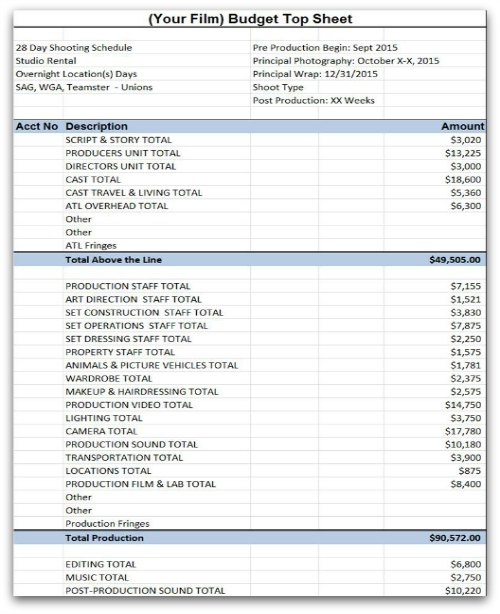
Several Budget Top Sheet templates are available online. Find the one you’re most comfortable using.
Source: Fillm Proposals

Budget Top Sheet Organizes Expenses

Filmmakers work off a Budget Top Sheet. It provides a summary of how the money is allocated during the filmmaking process.

At the top of the top sheet is the general information used in forming the budget. The names of the producer and director are listed at the top because they are responsible for overseeing the overall budget. Other information given is the start date and completion date of the production. It is imperative to understand the top sheet, as any changes to it will affect the entire budget dynamic. The top sheet will inevitably change because the production stage of a film is the most liable aspect of the process. Unknown factors, such as location, weather, actors, stunt performers, and production issues, can cause liability.

Above-The-Line vs Below-The-Line Costs

Two distinct divisions separate the budget: above-the-line and below-the-line. Based on the early days of Hollywood, the positions above the line were the more important creative elements in the production, such as screenwriters, producers, directors, and actors. Any costs relating to these categories were above the line. The below-the-line division is subdivided into the production period, the editing period, and miscellaneous overhead expenses associated with the entire production process. Obviously, a production designer, an art director, a cinematographer, a sound designer, a composer, an editor, and a costume designer are all important creative forces. Still, their costs fall below the line. It is a wise filmmaker who recognizes that everyone working on the production is an innovative resource because filmmaking is a collaborative process.

Each production has unforeseen costs.
Source: Cottonbro Studio

Above-the-line production positions recognize the four guilds that classify certain creative personnel on a project: the Screen Actors Guild, the Directors Guild, the Producers Guild and the Writers Guild. We find all the rest of the union and federation members below the line.

Adding the above-the-line costs and the total below-the-line costs presents the direct cost for the whole production. Remember, this is not the final budget, as other unforeseen costs may arise. A contingency line is added to the top sheet for those unexpected elements. The contingency is predetermined as a percentage of the overall budget. Ideally, a 10 percent contingency fee should work. However, some productions have been as high as 30 – 40 percent. A contingency fee is the requirement for procuring a completion bond. Therefore, the direct cost, the contingency fee, and the completion bond make up the total cost for production. The top sheet of the budget also includes “other fees,” such as bank interest or other indirect costs that the filmmaker may not be aware of until after the budget is finalized.

What are Deferments in Film Production?

On the top sheet of the budget, you can include deferments. This is when the filmmaker determines that the available funds for the production are insufficient to cover the talent or services. The idea of deferred payment was introduced and developed in the 1970s. The advantage of deferred payment is that one doesn’t have the money or wherewithal to pay for the talent or services. As a result, they can pay them later. The disadvantage is that the talent or service can charge interest on the deferred payment, which will cost the production more money than if they had paid them upfront, and deferred payments are added to the negative cost. Then, the filmmaker will have a reputation for exceeding the production budget. Negative cost is the expense of producing a film. It excludes such costs as distribution and promotion. An example of a sound deferment is the Directors Guild allowing producers to hire its members based on the project’s budget. If the amount is less than $6 million, they pay 70 percent of the salary to the director, while the remaining 30 percent is deferred. In the bargain, they pay an additional 25 percent to the director for agreeing to the deferment.

The filmmaker should explore all options to keep the project within its budget while maintaining creativity. Yet, the producer pays attention to innovative suggestions that deviate from the original financial plan. It’s their job to help the project stay within its financial limits.

Although a budget is created for the overall production, it serves primarily as a guidebook for making decisions within the budget’s parameters. The budget must always stay within those parameters. If it does, the filmmaker must seek additional funding to complete the project.

As the project moves into production, it will take on a life of its own. You must safeguard your creative vision while avoiding getting lost in budget misfortunes. That is where the line producer comes in and manages the overall production flow.

The Indie Producers Handbook: Creative Producing from A to Z

The Indie Producers Handbook: Creative Producing from A to Z

This is my go-to book for film production. I recommend reading The “Indie Producer’s Handbook: Creative Producing from A to Z,” written by a film producer, Myrl A. Schreibman. It delivers a comprehensive and practical guide to running a film on a budget.

Film Career: Professional Set Painter

What is a set painter?

Set Painter Jobs

If you are a professional painter and want to expand your career, consider being a set painter for the film industry. This article explains how you can become a set painter on a movie production.

Being a set painter is not being a painter of army paint sets. Though young and old kids enjoy the hobby of painting a whole regiment of army paint battlefields set, this is a real job on a film set design.

When hired, you arrive with your paint supplies ready to paint the set or stand by if they need a quick touch-up while filming a scene.

If you are a professional painter or like to paint houses, buildings, and fences, and want to expand your career, consider being a set painter for the film industry.

You meet talented people from all over the world. The pay and benefits are exceptional, and you work in a very creative environment. You’ll meet movie stars!

Runaway Productions Create Local Film Production

“Runaway productions” is a term used to describe films produced outside of Hollywood on location. The film industry coined these words because productions often move away from Hollywood to make more money. It is not profitable for Hollywood, but it is excellent for you to live outside Hollywood and get a job in film production as a set painter.

Certain cities, like Seattle or San Francisco, invite runaway productions to film in their area because they want the money. Some, including states, offer credit or tax incentives, like Massachusetts or Georgia, to save film production money.

Build your contacts—use business cards—to procure more work after the film wraps.

Cold Call Film Offices

How Do You Get Hired onto a Film Set?

Pull out your yellow pages phone book and call film commission offices to see if they can add you to their list of set painters available for work. The idea is to get a set painter job on a film production that comes to town or within a 100-mile radius. Work on the production to start developing your resume, including film credit.

Start as a set painter on a film as a non-union member. Build your contacts—use business cards—to procure more work after the movie wraps.

You might get a gig as the head painter or standby painter.

Become the Lead Painter

Discover how quickly you will advance to another production. You might even get a gig as the head painter or standby painter. The secret to doing this is getting to know the production designer of each job you get in film production. Say something like, and mean it, “I want to work with you again.” It can escalate from there.

Carve a little niche for yourself as the only painter in a 100-mile radius who works for films, television, and commercials.

Work Within a 100-mile Radius

Establish yourself as the lead painter in this 100-mile radius. That way, your reputation leads you to more work. One production designer will tell another production designer, who will tell another, and well, you do the math—that’s a lot of painting gigs.

Remember that word of mouth is the best impression of whether or not you work in this industry.

Keep in mind that word of mouth is the best impression on whether you work or not in this industry.

Painter’s Success Story

Steve is a scenic artist and head painter who paints movie sets. He makes the wood look like metal. Metal looks like wood, the old look new, and so on.

In the movie production of Don Juan Demarco, the crew painted the whole town while Steve put moss in the fountains and used dark green auto paint on the water.

How did Steve get his first job? He told a carpenter he worked with, who was going on to a TV series production, to call him if they needed any painters. They did, and he went to work in the paint department.

Steve studied art in high school and worked as a construction draftsman and illustrator in the Army. He then attended the Art Institute of Chicago for a year. For over fifteen years, he has designed and painted television sets.

He joined Seattle IA Local 15. However, the union was not doing what the members needed to find work in the film industry, so Steve pitched in and helped form Local 488, a local union for studio mechanics. After he moved to L.A., he joined 729 local painters but kept his membership in Local 488.

How Much are Union Fees?

Fees vary by the location of each local union in each city. The LA Local 729 is the best union to contact for more information.

Steve says working in films is a team project. If you get the reputation of being hard to work with or self-centered, the word gets around. Dealing with high pressure, tight deadlines, and last-minute changes is essential.

“But, those in my position, a seasoned set painter, at my level get jobs on our own.”

Film Production in Various Cities

Steve says the union has helped him get work by being a member. “But those in my position, a seasoned set painter, at my level get jobs on our own.”

In addition to Seattle and Portland, Steve worked on features in Minneapolis, Memphis, Cincinnati, Salt Lake City, Hong Kong, and Twin Falls.

Of course, he always worked on shows in Hollywood, even before moving to Los Angeles, the heartland of moviemaking.

How to Become a Location Scout

Production designers, artist directors and directors need competent location scouts. Source: Rafal Maciejski

Have you ever thought of being a location scout or manager?

Location Scouts and Location Managers

Do any of these jobs interest you in having a career in film? Read on and let me know your thoughts on being an art director, location scout, or location manager. All three jobs place you right in the film industry—right on the set, working with the producer and director.

Location Scouting: A True Art Form

Location scouts get hired early in the pre-production phase of making a movie. Location scouts or location managers work with the art director and director to find the ideal location for a particular shot in a film scene.

Nathan works all over the world as a location scout. “You are trying to interpret the script while finding the right location that can make all the difference in the movie.”

He makes the director’s job easy because he finds the environment suitable for the story. A location scout finds the house for the perfect location to shoot the scene. It makes all the difference in the world to be sharp and intuitive as a location scout.

Norman Reedus of “The Walking Dead” gives homage to the location scout.

The Ingenuity of the Location Scout

While it’s true that the art director and director get all the credit, it all starts with the ingenuity of the location scout.

The location scout will find the location for the director and then get the director’s approval. Usually, when the film goes into production, the location scout will switch hats and become the location manager.

Location Scout Salaries

A location scout is a glamorous job, but the pay is not outstanding. On average, an independent contractor location scout makes around $81,000 to $111,000 a year.

Location scouts who work for a production company will make about half of what an independent contractor does, but working for a production company guarantees a steady paycheck.

Do Location Scouts Travel?

Some reports on the internet state that location scouts travel around the world. If they work for a production company, of course, that could be true. But most location scouts work in their local area.

If they are independent contractors, they work in their local region.

One particular scout works in the Northern California area and rarely travels. He would only if a former client asked him to scout for production outside of his jurisdiction, but that was very rare.

Financially, it is easier for a production company to hire a local scout because they are familiar with the area.

There are times when a production company cannot hire a local scout because no local scout is available in the area. Then it would make sense to hire one the company has worked with before since they have an established rapport and work ethic.

Being a location scout for a film can be a rewarding experience.

Scout to Manager

Some location scouts stay with the production after scouting and become the location manager. The reason for this is that a location scout often helps with permits and other city regulations for the production even before filming begins.

Since the location scout is familiar with the locations and working permits, it makes sense that the production company keeps them on the payroll.

The location manager handles all the logistics of using the location, such as permits and approval from local governments. Whenever problems arise on-site, it’s the location manager’s responsibility to handle them.

Such things that could arise are noise control or crowd control. Even when the electricity goes out, the location manager quickly remedies the problem.

They are responsible for ensuring that filming can continue at that location—because time is money in film production.

Being a location manager is a bit tense at times. Nathan is an independent contractor, and he has a lot of freedom. “I am pretty much my own boss.”

Location Scouts Work With The Artistic Director

Art directors work closely with the production designer. Together with the location scout, they design the physical environment of the film set. Their job is to create the mood that the script dictates to the director.

Art directors supervise many different people in the production, such as illustrators, scenic designers, model makers, carpenters, painters, electricians, laborers, set decorators, costume designers, animal makers, and makeup and hairstyling artists.

Art directors are architects or come up through the ranks of theater designers or set designers. It is not uncommon to hear how an art director favored carpentry or stagecraft in school.

After finding the location and working with the location manger, the artistic director molds any area and turn it into what gives life to the characters and energy to the story. They take an exterior location of a building and match the interior of the same building on a soundstage.

They stay on top of the latest techniques for creating any visual look the producer, director, or production designer needs to ensure the movie’s success.

Getting a Job in Hollywood

Any one of these positions provides an entry to the motion picture industry, whether in a major city or on location. You can move up to being an art director, production designer, or even a director from these positions.

Many begin these jobs in theater productions, move to film and television, and then move back and forth between the stage, film, and TV.

For these people, happiness is working in the entertainment field and making a living at what they like to do best—creating an environment that helps tell a story and make it real for the audience.

Being a makeup artist

How to Be a Successful Makeup Artist

Renae Goodhew is one of the most in-demand VFX and makeup sorcerers in Hollywood. Horror is her specialty.

Being a makeup artist in the industry gives you a chance to live your dreams. Hear how the pros built their careers working in film.

Makeup Artists on Movie Sets

I know some talented makeup artists in the industry, some in San Francisco and others in Hollywood. Being a makeup artist can be a fun and challenging job.

The hardest part is establishing yourself in the industry. You start at the bottom and work your way up to the top. If you appreciate working with people intimately and helping them look their best for the camera and fans, you will do fine.

But you must be willing to work hard and be on your feet all day. You will most likely be one of the last people to leave the set. The job is yours if you can handle its responsibilities.

Once you have your foot in the door with steady and well-paid work, you can keep it glamorous by setting up appointments with celebrities before red carpets, interviews, and the like. Or you can work on a film set. Whatever you desire.

Whatever you choose as a makeup artist, you must keep your integrity and never bank on your profession. Keep your cards to your chest and your nose clean. You will succeed far more than your dreams could imagine.

Makeup artists enjoy themshelves and know they are taking a step in the right direction.

Reana Goodhew Makeup Artist: Independent Horror

Reana Goodhew’s credits include One, a Lance Henriksen horror movie; a horror movie with Eric Roberts called 7 Deadly Sins; William Baldwin and Bill Moseley in Minutes to Midnight; Tony Todd, Bill Moseley, and Kane Hodder in Harrison Smith’s Death House. She also worked on the “555” video by Jimmy Eat World.

“I’m a huge horror fan. The first horror film I saw was The Exorcist, with Dick Smith’s makeup. From there, I fell in love with all the Hellraiser movies, Halloween, and so forth.”

Goodhew talks about becoming a professional makeup artist in Hollywood. “I like the challenge of creating good horror makeup. Making something horrifying look truly believable is a challenge,” she exclaims.

She also enjoys working in horror because “you’re able to create things aside from application makeups.” She is talking about creating body parts, wounds, dead bodies, fake heads, and so forth.

“I definitely get to use my artistic background to create and color, which I enjoy,” adds Goodhew.

She has been working as a special effects makeup artist for seven years. Her background comes from art in painting and sculpting, but she attended the Cinema Makeup School.

Creating Body Parts, Wounds, Fake Heads, and Dead Bodies

The advice Goodhew gives to those who want to work in Hollywood:

“Work hard, be persistent, and always keep pushing yourself. As an artist, we never stop learning or growing in our career. Always try to build on your skills, even when you’re not working on a job. Not everyone will have the same path pursuing makeup as a career. There are so many options. Ultimately find your path and go with it.”

See the Echoes of Fear trailer below to see some of Goodhew’s creature work.

Laura’s Stage Jobs

Laura lived in Los Angeles and worked at a cosmetic counter when she got involved in doing makeup on performers for school plays.

While putting makeup on the performers, she studied and learned various stage makeup techniques, and eventually knew how to apply all types of makeup on a performer.

In the process, she discovered how much she liked doing makeup and flourished in her career.

Makeup artist can live in Los Angeles, San Francisco, or New York

Makeup Artist Movie Jobs

Deciding that she wanted to make this her career in films, Laura got in touch with some major studios.

However, they wouldn’t hire her because she wasn’t a union member and needed a job to be in the union.

The common problem for most novices in film careers is that you need the experience to get a job, but you can’t get experience unless you have a job.

Laura decided to contact several independent movie companies because independent films often have agreements with the union that they don’t have to hire union members.

With some persistence, she talked her way into a job on a biker movie as a makeup assistant, helping the makeup artist do whatever she wanted her to do.

Another essential point to breaking into the film business is to do whatever the production needs to help get the movie made. You have to be willing to work hard and be ready to serve your immediate boss.

Oscar Winner Joe Harlow Sets the Tone

The remake of Hellboy revamped the character and makeup design with Oscar-winning Joe Harlow set the tone for the crew to create a new Hellboy character.

In a press junket interview, Harlow talked about designing the look of Hellboy and imagine how much work went into creating the comic book anti-hero.

Lucas Godfrey’s Special Effects Makeup for Hell Fest

In an interview with Lucas Godfrey, who did special effects makeup for the horror movie Hell Fest and The Walking Dead series, talks about his experience with special effects makeup during the production of Hell Fest.

Watching these types of interviews helps you understand what these people do and who they are. The more you know about them and their credits, the more chances you have of recognizing them and their work.

Nothing impresses an artist more than someone truly recognizing them for their work in films.

Reese Witherspoon looks dazzling because of her talented makeup artists.

One Way to Get Started as a Makeup Artist

Laura’s advice for those who want to do special effects makeup is to get a job selling cosmetics.

“Once you learn the basics,” she says, “you can offer to do makeup for school and community theaters or talk to your friends into letting you practice on them.

The important thing,” she asserts, “is to practice your craft.”

Depending on the production, makeup artists on a film set make roughly $40–$50 an hour. They make $73,250 to $88,200 or more a year.

Working With Sir Anthony Hopkins and Anne Hathaway

Makeup and hair designer Nana Fisher worked with Sir Anthony Hopkins on Armageddon Time. In an interview, Fisher discussed working with the actor and their steps to show his character’s health decline.

Fisher talks about the skin color choices, such as yellow, green and grey.

In another interview, Fisher talked about matching the hair colors of the family. She talks about working with Anne Hathaway.

Makeup Artists Salaries

All in all, you can live your dream and become a makeup artist in any field. Laura entered a fabulous field that is rewarding artistically as well as financially. The same thing can happen if you learn your craft and start finding jobs.