Category Archives: book

“Bolden” About The Man Who Invented Jazz

Who Invented Jazz?

Charles “Buddy” Bolden’s story is haunting and captivating, marked by extreme highs and terrifying lows. Few people are familiar with his influence on the music culture, yet his musical ingenuity touches us fundamentally and socially.

He invented one of America’s few homegrown art forms, including its first and most important cultural export: jazz.

Growing up in New Orleans toward the end of the 19th century, he developed a new music style. Some describe it as fusing blues, gospel, and ragtime, calling for rapid improvisational rhythm. He played his cornet’s warmth and arousal sound like no other.

“Very little is known about musician Buddy Bolden:

He was born on September 6, 1877.

He was committed to an insane asylum in 1907, where he died in 1931.

Very few pictures of him exist….But Buddy Bolden invented jazz.”

American-Made

Jazz is as American-made as apple pie. The art form emerged about 120 years ago, when musicians gathered in inspiration, devotion, angst, and revelation. The splendor of jazz is between the musical notes, and its origins are veiled in an alchemy of mystery and allure.

Carr plays the trumpet as "Buddy."
Carr plays the trumpet as “Buddy.” | Source

Origins of Jazz

Quite possibly, the mystery of jazz’s origins stems from one of the first gifted musicians in this genre. Charles “Buddy” Bolden remains virtually unknown. Born in New Orleans in 1877, he became a bandleader spectacle before Louis Armstrong.

He was the first cornet player to surface from ragtime and blues, playing a fresh, new form. “Buddy Bolden’s Blues” (“I Thought I Heard Buddy Bolden Say”) by Jelly Roll Morton is one of the first and rare acknowledgments to the shadowy artist called “King” Bolden. Director and writer Dan Pritzker decided to change that and shed light on Bolden’s life and times.

The movie poster promoted the dynamic film.

Using the screenplay Pritzker wrote with David Rothschild, he innovated the musician’s life and chose to be creative with Bolden’s story. The movie immerses the audience through images of his lively and tragic life.

Each frame comprises the social framework in which Bolden grew up and developed revolutionary music. Pritzker focuses on inspiration from artists like Louis Armstrong and the musical style of the period.

Bolden engages the audience, starting with the early 1900s in New Orleans. Buddy Boden, played by Gary Carr, was broadly known as the “King” of New Orleans jazz. He took an innovative approach to music by merging ragtime, gospel, and blues with distinct improvisational riffs.

A clip from the movie shows a young Bolden sheltered under his mother’s sewing machine at the sweatshop. He fantasizes about the beat and sounds of the shop, with women workers ballet dancing to the equipment’s sounds: the movie trailer and other clips from the movie show Bolden at different points in his life. Most clips are triumphant and tragic, but the story is sad.

Coming Through Slaughter by Michael Ondaatje, who wrote The English Patient, tells Bolden’s story in poetic passages of his life. Ondaatje writes about how Bolden drank heavily as a barber by day and a musician by night. One night, he went crazy and was locked up in a pre-Civil War asylum.

On the contrary, the movie introduces us to his wife, Nora, played by Yaya DaCosta. She profoundly loved him and endured emotional pain because his personal life was not stable. His manager, Buddy Bartley, played by Erik LaRay Harvey, managed him through jubilant highs and precarious lows.

Yaya DaCosta as Nora Bolden with Gary Carr as Buddy Bolden
Yaya DaCosta as Nora Bolden with Gary Carr as Buddy Bolden | Source

The film jumps to 1931, showing the incredibly trendy trumpeter and singer Louis Armstrong, played by Reno Wilson. He returns to New Orleans and becomes one of the first African-American entertainers broadcast on the radio. Ironically, Bolden was experiencing his last days in the Louisiana insane asylum at the same time.

Reno Wilson as Louis Armstrong
Reno Wilson as Louis Armstrong | Source

Pritzker’s passion for telling Bolden’s story goes back decades. A guitarist for the Chicago-based rock/soul/R&B band, Sonia Dad, introduced Bolden’s story to Pritzker by recommending the nonfiction book “In Search of Buddy Bolden” by Donald M. Marquis.

Marquis is from Indiana but lives in New Orleans. He works at the New Orleans Public Library, spending most of his time researching jazz history and writing for jazz publications. Compared to Ondaatje’s book, he is well-researched with documentation and acknowledges a team of researchers who helped him uncover the life of Bolden.

“Jazz does not belong to one race or culture, but is a gift that America has given the world.”— Ahmad Alaadeen

Pritzker recalls reading Marquis’ book for the first time while touring with Sonia Dada. A friend introduced him to a book about Bolden, the creator of jazz. It got his attention, but it was a ridiculous concept, like saying this guy invented water or lightning. The truth is, Bolden set the stage for jazz. Pritzker says it is a tragedy because Bolden’s music impacted his life, even though he had never heard of him until now.

Dan Pritzker (Director) and Wynton Marsalis.
Dan Pritzker (Director) and Wynton Marsalis. | Source

Jazz musician Wynton Marsalis composed the film score and served as an executive producer. He hopes the film shines a positive light on the cornet player so people respect our musical history and culture.

Marsalis is from New Orleans and plays the trumpet; he has won multiple Grammys and was the only entertainer to win Grammys for jazz and classical recordings in the same year, the inaugural musician to win the Pulitzer Prize for music.

All the music that came after Bolden and Marsalis was associated with cornet solos and the style of variations. But he was surprised people didn’t talk about him as a cultural influence. He played loud music, had many women, and he drank too much.

Legendary jazz musicians recall Bolden’s work and life as if it were a myth. There are no recordings of his music or documents of his life. His career began as the famous King Bolden, but ended in a Louisiana insane asylum, where he spent the last 25 years of his life.

More About Jazz

Harry Potter Obsession

J. K. Rowling’s Books

If you are a Harry Potter fan, you have most likely read all of J.K. Rowling’s books. If you are not a reader, then you watch the Warner Bros. movies. They grabbed your attention, and you couldn’t get away. The obsession with the Harry Potter stories is worldwide, whether it’s the books or just the movies, or both. The story is one that the whole family can experience together, and I highly recommend it. When your family decides to watch Harry Potter and the Half-Blood Prince, snuggle up because it’s time to share a much darker and deeper Harry Potter movie than the earlier ones.

Moviegoers’ first reaction to Half-Blood Prince is how much those kids have grown up. They look so much older, and the story grows with them and gets darker. The actors surpassed their adolescence, and the characters have mastered their wizard training. If you have read the book, you are aware of the movie’s overall plot and outcome.

Sure. The story is darker, and Harry Potter learns more about Voldemort’s dark secrets and how to overpower the evil wizard once and for all. One main character in the story will perish, which is a pivotal point in Rowling’s series and may be hard to bear.

Harry Potter Books or Movies?

Those surveyed indicated that 50% had read the books before seeing the Harry Potter movies. The other 50% split between seeing the films and then deciding to read the books, and never reading the books at all.

Yates Directs Harry Potter Movies

David Yates directs the movie, and he is by far the best director of the franchise, as evidenced by his return to finish the last three installments after directing Order of the Phoenix.

Yates’s experience as a British television director keeps the story above the special effects. Yates told IMDB, “I like to create an atmosphere where actors feel safe enough to take risks. I certainly don’t believe in being a macho bully. I’m not interested in frightening good work out of people. It’s bollocks,” he continues. “In an ideal world, I’d bounce between big projects and no-budget TV dramas with fantastic scripts. Many Hollywood films tend to be bloated, bombastic, and loud. At the same time, I do like the infrastructure of making a blockbuster; it’s like having a big train set.”

Young Tom Riddle

In Half-Blood Prince, we discover detailed information about the young Tom Riddle, the boy. He eventually grows up to be Lord Voldemort, played brilliantly by Hero Fiennes-Tiffin, the nephew of Ralph Fiennes. Ralph Fiennes plays Voldemort, which makes the casting quite a family affair.

Another new cast member of the franchise is Jim Broadbent as Horace Slughorn, the new potions teacher, a plot-driven character in the Harry Potter story. Broadbent’s resume is extensive and probably one of the most favored character actors in the U.K. and the U.S.

Rowling’s Final Scene

So, sit down with your family and enjoy the sixth installment of the Harry Potter films. At the end of the movie, Harry reflects with Ron and Hermione on the difference between him and Voldemort. It’s a meaningful line and poignant, which is why we read Rowling’s series and flock to see Harry Potter movies.

“Harry Potter: Hogwarts Mystery Mobile Game”

Even though we read the books, watch the movies, and see spin-offs like Fantastic Beasts, a Harry Potter: Hogwarts Mystery Mobile Game offers a chance to play a game set in the franchise. The mobile game is just another way to enjoy Harry Potter.

Play the video promoting the new game, and you will see some reactions to the game from real Harry Potter talent, like one of the Phelps brothers. The game launch at the Wizarding World of Harry Potter in Orlando was exciting and eventful for those who attended.

It is one of the first games where players experience being a character they choose and a Hogwarts student.

Future of Harry Potter

With spin-offs from Harry Potter stories, the new television series, the play Harry Potter and the Cursed Child, the theme parks, and mobile games, you walk into a Barnes & Noble bookstore and see Harry Potter fandom from the original story, Fantastic Beasts. Anything is possible with such a fantasy story.

Rowling’s work inspires people to dream and to be part of the Wizarding World of Harry Potter, or to write their own fantasy books where families and friends bond, sharing a fanciful reality.

Screenwriting: Scenario Construction

Screenwriting: Scenario Construction

Writers need to master their craft by studying and practicing screenwriting. One of the first books on screenwriting is The Photoplay Handbook of Scenario Construction. It was published in 1923, during the silent film era, a time before the term “screenwriter” was in use. The advice in this early screenwriting book still applies today:

“Our ultimate purpose, as a photo playwright, is to arouse the emotions of the audience–to make them weep, to grip their hearts with pity, to thrill them, to make them laugh, and fear; and shed tears of joy. We strive to achieve these things by leveraging the actions of the people we create. We make our characters struggle, suffer, and win and lose in their fight for happiness. Every act of every character may be regarded as an effect.”

Those words were accurate in 1923, and they remain so today.

Screenwriting is writing your story with vision and action.
Screenwriting is writing your story with vision and action. | Source

Writing the Picture

Another great book about screenwriting is Screenwriting: Writing the Picture by Robin Russin and William Missouri Downs. It is a virtual screenwriting class for a fledgling screenwriter who wants to enroll in a college screenwriting program but can’t for whatever reason.

The college textbook begins with a professional perspective on how screenplays can be read and valued in the industry. It proceeds to chapters that deal with the character, theme, and story environment.

Then, there are six complete chapters on story structure, from historical approaches to how genre influences screenwriting form.

The book also devotes chapters to pitching, rewriting, and creating a career in television and playwriting as viable alternatives or adjuncts to writing for movies.

Top Screenwriting Program

Russin and Downs both received their Master of Fine Arts in screenwriting from UCLA. The university’s screenwriting program is considered one of the top programs in the country, boasting notable alumni such as Michael Webb, Michael Colleary, Jonathan Hensleigh, and Ed Solomon. Russin and Downs each won the Jack Nicholson Award for excellence in the field.

Russin wrote, produced, and directed for television, theater, and movies. Downs, an award-winning playwright, has sold feature screenplays and written as a freelance and staff writer on TV.

I spoke with both Russin and Downs about screenwriting and invited them to share their vast knowledge of the subject. I took copious notes while we kept ourselves pumped with drinks.

Talking with Robin Russin and William Missouri Downs

Both working writers and teachers, “Bill and I were frustrated by the many books out there that approached the process of writing from an ‘after the fact’ standpoint,” explains Russin. “They attempt to show how a script should be written by taking something finished and assuming that by critically dissecting it, a writer can then figure out how to create something new.”

Russin believes this approach is helpful and can be used to some extent. “It doesn’t really get at the core problems encountered by someone who is approaching the blank page, trying to get a handle on what and why and how they should be writing. There’s far too much ‘if you write it, they will come’ pie in the sky cheerleading, and far too little hardcore advice on how to make sure your script will not only be artistically successful but survive in the marketplace.”

Royce Hall is the defining image of UCLA.

Create Characters, Dialogue, Environment, and Structure

They wrote the book because of the numerous subpar screenwriting books available. “We wanted a book that concentrated on all techniques, not just one method of writing a screenplay. Our book covers just about anything you want to know about screenwriting,” explains Downs.

Russin agrees, “Probably the most valuable aspect of the book is that we go into much more specific detail than most in terms of how to create characters, dialogue, environment, and especially structure.”

The heart of our book is a six-chapter section devoted to explaining how the structure works on a deep level, rather than a superficial, put a plot point on this page approach. “Most books out there push a specific formula to be imposed on the screenplay. After years of both writing and teaching, Bill and I came to realize that in fact, no formula–even the hallowed three-act structure applies to every screenplay, or even to most of them,” explains Russin.

Familiar Movie Formulas

“These are straitjacketed approaches to a fluid, organic process, and so we wanted to come up with something that would free the writer to create in new and inventive ways. But we also included a very detailed description of the various familiar formulas, both because it’s important to know the terminology and expectations of producers who are familiar with those formulas and because our philosophy is that whatever gets the job done is the right approach.”

“The book is a graduate-level college textbook on screenwriting. It covers the whole spectrum. That is the book’s most valuable aspect,” concludes Downs.

Start Writing Screenplays

It’s up to you to decide whether to go to college and get your degree in screenwriting or start writing screenplays. Either way, you still need to write a script to be a screenwriter. The more you write, the better you will become as a screenwriter.

Do You Need a Degree to Be a Screenwriter?

Learn for Goldman's book because he is the best.
Learn from Goldman’s book because he is the best.

“Nobody Knows Nothing”

Screenwriter and novelist William Goldman wrote “nobody knows anything” in his bestseller, Adventures in the Screenwriting Trade: A Personal View of Hollywood and Screenwriting. Hollywood jolted, agreed, and repeated those words as rites of passage for any fledgling screenwriter.

Thus, a fledgling screenwriter might ask, “Do I need a degree in Screenwriting to be a screenwriter?”

If you read Goldman’s book, you might be inclined to think not. However, there is no harm in inquiring about UCLA and USC Screenwriting programs. The programs launch careers and attract hopefuls.

Screenwriting, How to Do It

Adventures in the Screenwriting Trade was written in 1982 and is dated. It’s worth the read for anyone considering a career in the film industry, whether as a screenwriter, producer, or director. Goldman is the wise mentor in his book on navigating Hollywood.

Goldman places you in his shoes and walks you on a journey — an adventure where you observe, learn, and realize the hard work it honestly takes to succeed in Hollywood.

Be it on the set of Marathon Man with Lawrence Olivier and Dustin Hoffman or catching an unforgettable and poignant moment between the famous, then divorced, Hollywood couple Robert Wagner and Natalie Wood — their ingenious scene was written as a screenplay.

Is Luck and Timing Learned in a Classroom?

Goldman defines who is who in Hollywood and the instrumental role in getting a film made or not made. Their roles in bringing the movie to life. Something you most likely will not learn in a classroom.

He even mentions legends such as Joseph Mankiewicz, John Huston, Billy Wilder, Sydney Pollack, Robert Redford, Paul Newman, and Norman Jewison.

He discusses the difficulties of writing and rewriting notable movies, including All the President’s Men, a Grand Hotel remake (which never materialized), and The Right Stuff. Losing deals and the sheer timing of getting the jobs back. Which raises the question: “Is luck and timing learned in a classroom?”

“Her heart was like a secret garden, and the walls were very high.”— “Princess Bride” by William Goodman

“Butch Cassidy and the Sundance Kid”

Goldman includes his popular script, Butch Cassidy and the Sundance Kid, along with a five-chapter dissertation on its strengths and weaknesses. Any screenwriter who reads these chapters learns multitudes of screenwriting tips.

Nevertheless, there is more. Three chapters strictly focus on adaptations in which Goldman uses one of his short stories as a model, with critiques from major Hollywood players — all the better for writers.

Goldman resonates with such words as, “And in movies, the screenwriter is the odd man out.

But there is a trade-off. That beginning lap we run, regardless of what happens later — that lap is ours. We have the privilege, if you will, of the initial vision. We’re the ones who first get to make the movie…”

I sensed a bit of cynicism, but who can’t help but detect such skepticism if you had walked in his shoes?

Sundance: I can’t swim!

Butch: Why, are you crazy? The fall’ll probably kill you.— “Butch Cassidy and the Sundance Kid” by William Goldman

The Princess Bride: An Illustrated Edition of S. Morgenstern's Classic Tale of True Love and High Adventure

The Princess Bride: An Illustrated Edition of S. Morgenstern’s Classic Tale of True Love and High Adventure

Goldman wrote The Princess Bride, a 1973 fantasy romance novel, and it is considered his best work. The story combines elements of romantic love, comedy, adventure, fantasy, and fairy tales. The names of the characters alone bring great delight to my imagination. With names such as Buttercup, Inigo Montoya, Fezzik, and Prince Humperdinck, it’s fanciful. However, Westley is a common name. I am awed by his talent because he not only writes screenplays but also novels. He writes in various genres, not just Westerns or political thrillers, which has made him famous. His work inspires me to write and to write well.

 Buy Now

Taylor Taylor, Kathryn Stockett Friendship

Friendship

The making of The Help has a backstory about two friends who helped each other break into two competitive fields: publishing and filmmaking.

Director and screenwriter Tate Taylor and author Kathryn Stockett were childhood friends in the 1970s. They grew up together in Mississippi. Their friendship lasted into adulthood when they collaborated on a book and movie about social standing in the 1960s South – The Help.

Friend Helping a Friend

Stockett took five years to write the novel and over 60 rejections from literary agents. Then, she approached Taylor with her dilemma of not getting published. Being a close friend, Taylor was sympathetic and decided to read her manuscript. He was “blown away” and emotionally moved by the story’s truth because he grew up in the same southern culture as Stockett.

Taylor supported Stockett, saying that her manuscript was fantastic and that she shouldn’t give up. He promised he’d make it into a movie if it didn’t get published.

Black Versus White America

The story concerns unlikely women coming together to make a change in Mississippi in 1963. One woman is a writer researching Black women raising children in White households. The black woman and the writer become friends as they try to change the terrible conditions of black women working for white families in Mississippi.

Taylor and Stockett were both raised by single mothers who worked full-time. Like the women in the story, they needed help raising their children. Taylor and Stockett called these women who helped them grow into adulthood “co-mothers.”

Great Interview

“I didn’t think so, honey. Every day you’re not dead in the ground, when you wake up in the morning, you’re gonna have to make some decisions. Got to ask yourself this question: ‘Am I gonna believe all them bad things them fools say about me today?’ You hear me? ‘Am I gonna believe all them bad things them fools say about me today?’ You hear me today? All right? As for your mama, she didn’t pick her life. It picked her. But you, you’re gonna do something big with yours. You wait and see.”— Constantine Jefferson in the movie.

Promise Pays Off

So, Stockett’s career took off with her bestseller, and Taylor wrote the adaptation for the silver screen and directed it with a great cast.

The Help was published and became an ultimate bestseller. But Taylor remembered the story because of its authenticity. It continued to resonate with him from the moment he opened the book. He thought the story reflected his childhood friendship with Stockett, even though their lives differed from those of the characters.

Their story offers a solution for those who want to break into writing or filmmaking, reminding them of their childhood friends as sources of inspiration or help. Either way, collaborating on a project with a childhood friend is a rewarding way to keep the friendship growing and lasting forever.

Having friends who help you is meaningful and gives value to life. The story of Stockett and Taylor assisting each other and working their way to success in their chosen careers tells us who they are as individuals.

Tate Taylor and author Kathryn Stockett were childhood friends.

Strange Friendships

Tate Taylor continues writing and directing. He directed the movie MA, which starred Juliette Lewis, Octavia Spencer, and Luke Evans. Taylor and Blumhouse produced the film. It is a psychological horror-thriller about a lonely woman who becomes friends with a group of teenagers and allows them to party at her house.

The teenagers think they’ve got it made, partying like adults. The woman begins acting strangely in a horrific way, and it turns out she is not as friendly as they thought. Octavia and Tate were roommates before their careers flourished.

Roommates

In a couple of interviews with MA producers, they reveal that Taylor is one of the kindest directors and makes friends with everyone. Taylor and Spencer were roommates for seven years. It turns out they are the best of friends. Because they were roommates and friends, he knew Spencer would want to play Ma’s role because she loves true crime stories.

Again, friendship in the film business helps build careers. Keep that in mind as you develop your film career—create relationships.

Spielberg With Crichton: “Jurassic Park” and “ER”

Steven Spielberg and Michael Crichton made a great creative team.
Steven Spielberg and Michael Crichton made a great creative team. | Source

Friendship With Benefits

Steven Spielberg and Michael Crichton developed motion pictures and television programs, notably the Jurassic Park franchise and the long-running ER series. The two men, who were dear friends working together, are a fascinating story of success.

Dinosaurs from “Jurassic Park”

An acquaintance, a high school teacher, told me about a time he showed his students the movie Jurassic Park. At the end of the film, some of his students thought dinosaurs were still alive on our planet. Not that the students were stupid. The movie was realistic enough to make the dinosaurs appear real in their minds’ eyes.

The movie’s detailed and realistic images of various dinosaurs, along with its story, acting, and sound, created a realistic world based on Crichton’s bestselling novel.

The original movie focuses on a devastating effort to produce and clone dinosaurs for an innovative theme park.

The franchise began in 1990 when Spielberg grabbed the rights to the unpublished book. Universal Pictures and Amblin Entertainment purchased the rights to the novel.

After four sequels, the franchise flourished, with the first two based on Crichton’s books, and it spawned tons of video games, comic books, and theme parks.

The franchise resurrected Richard Attenborough’s career and bolstered the careers of Jeff Goldblum, Sam Neill, Lauren Dern, Chris Pratt, and Bryce Dallas Howard.

Jurassic Park’s motion picture franchise includes a water excursion at Universal Studios theme parks.

The franchise movies alone have grossed close to $ 5 billion worldwide.

Crichton and Spielberg Winning Team

The success of the Jurassic Park franchise indicates that Crichton and Spielberg made a winning team. They invested their good fortune in an American medical television series that proved just as fruitful as the dinosaur movies.

Under the umbrella of Amblin Television, Crichton and Spielberg’s team created the medical drama ER. The show lasted 15 years and won several prestigious awards, bringing together famed talents that I will mention later in the article.

If anything, ER is a lesson in producing an award-winning television show and practically keeping it on the air for years. I am sure students of film and television classrooms study this series in its entirety. They identify and highlight the factors that contributed to the show’s high ratings and large worldwide audience.

Endless drama in an Emergency Room kept viewers glued to the TV.

Emmy Award Winners

The show won multiple Emmy Awards, with 124 nominations and 22 wins, reflecting the caliber of work that stood behind and in front of the camera, launching the stellar careers of George Clooney, along with Anthony Edwards, Noah Wyle, Julianna Margulies, and Maria Bello.

“ER”

Although I never watched the series as a whole, but as clips from different shows, I tend to shy away from medical shows. ER taps into the intimate workings of an urban training hospital and the critical issues faced by the dedicated physicians and staff of its vigilant emergency room.

Every week, fans glued themselves to the television and watched quirky and unique medical professionals save lives in a place where nothing is taken for granted or guaranteed. The emergency room doors open, and another distraught person or persons gets placed in their hands, life or death, within an hour’s worth of television programming.

Endless Series

Even though I didn’t watch the series, I watched the Collector’s Edition DVD of the 15th and final season, an all-time favorite of multiple emergency room drama shows.

The series lasted as long as it did because of the talented writers, as evidenced by the final season, particularly in the show’s ending. The arc ties into the earlier seasons, including Noah Wyle’s professional choices and personal life.

Now, Wyle is starring in HBO’s Emmy-winning The Pitt, very similar to ER, but set over one day in an emergency room in Pittsburgh.

Curtain Call

The final season is a curtain call for all the show’s lead characters. They returned one way or another, including those who died on the show.

One point of view about the medical drama is the large cast of major actors who left due to injury, death, firing, or disappearance. Like most long-running shows, I understand that cast members go in hopes of bigger and better careers.

The final season includes movie stars Angela Bassett and Courtney B. Vance. The main arc centers on Catherine Banfield, the ER’s medical director, played by Basset, and her husband, Russell Banfield, played by Vance. Both are intense and effectively support their respective sides of the issue.

The series ends well, and that is what matters to the fans. The finale is rewarding to those who faithfully followed the multiple storylines.

George Clooney

I am sure you’ll appreciate watching the episodes, knowing that you can watch them again and again since you own the DVD. The cast changing through the years might throw you off, but it is graced with guest appearances from Clooney and other original cast members.

If you still need an emergency room fix on television, there are similar shows that follow ER’s formula, which validates the series even more, such as Grey’s Anatomy, a long-running show as well.

How to Write a Crime Story

Write thrillers, mysteries, and other related crime dramas and avoid writing cliches by following these rules.

Joe Friday: “Just the facts, Ma’am”

Dragnet
Dragnet

Don’t use “Let’s take him downtown for questioning.” Roth writes that real cops never say that.

What is Attempted Murder?

The Crime Writer’s Reference Guide, 1001 Tips for Writing the Perfect Murder by the late Martin Roth, is not a book that you read for pleasure on a rainy Sunday afternoon.

When writing a story that requires an accurate portrayal of a crime, you reach for it and use it to describe blood. You’ll need to read it, though, so you know why you write with accuracy and detail a fictional crime story.

Of course, you don’t want to be as dry as a crime report, but you want to write real-life drama.

When you are writing a story that needs an accurate portrait of anything that deals with a crime, you reach for this book and use it for blood.

How to Become a Serial Killer

Take a story about a serial killer. You need to create a profile and look up serial murder in the book’s glossary. Turn to the designated pages and discover that there is not just one type of serial killer, but four. You read the passage in the book, “studies reveal that most serial killers are white males between the ages of twenty-five and thirty-five and are usually products of working- or lower-middle-class families.”

Your profile takes shape, and you read on, “Many serial killers are charming, selfish, impulsive, and ambitious. Many come from broken homes or homes where they were abused. Few serial killers express any feelings of guilt or remorse for their crimes.” A brilliant start for a classic character study. Now that I think about it, most of the crime stories I have read or seen in movies fit this profile.

Turn to the designated pages and discover that there is not just one type of serial killer but four.

Writing Crime Dialogue

I enjoyed the chapter on language. It is an essential tool for any crime writer, with terms such as “throwaway,” which refers to guns or clothes the mugger wears and discards to avoid pursuit.

How about “pigeon,” which means victim. This chapter supplies enough dialogue ideas to keep you writing dialogue for twelve CSI spin-offs. Wait, CSI spin-offs are close to twelve and counting.

All kidding aside, you need this book dog-eared and well-used if you write about crime.

How to Write a List of Character Traits

Reading the book filled my head with straightforward ideas for stories and ample characters. What also fascinated me was the character description of cops, including what their lives are like and what they are not like, which sparked a range of ideas. My fingers were itching to click the keys on my keyboard and start writing.

Roth’s book gives you all the information you need to create a crime. You can start with the criminal act, the crime scene investigation, the prosecution of the criminal, and conclude with a life sentence in prison. He offers numerous examples of television shows that accurately portray crime stories.

As an exercise, you can watch a few crime shows and see if the production company followed Roth’s standards.

Listen to the Police Dialogue

Mark Wahlberg stars in Mile 22, a drama about a secret special forces unit within the government. I recommend you listen to the dialogue in this movie. You will hear crime jargon, such as “motive” and “driven.”

Director Peter Berg shoots scenes with a handheld camera that follows agents, police, and special forces as they meet and collaborate to solve the crime.

Although it is a dramatization, you get the idea of what it’s like within a collaborative meeting between police forces.

Humphrey Bogart as Sam Spade

Humphrey Bogart
Humphrey Bogart

“He said: “I’m going to send you over. The chances are you’ll get off with life. That means you’ll be out again in twenty years. You’re an angel. I’ll wait for you.” He cleared his throat. “If they hang you, I’ll always remember you.”— Dashiell Hammett, “The Maltese Falcon”

The Crime Writer's Reference Guide: 1001 Tips for Writing the Perfect Murder

The Crime Writer’s Reference Guide: 1001 Tips for Writing the Perfect Murder

Finally, if the chapter you are reading isn’t enough to fill your creative imagination, which is hard to believe, there is a section called “Where do you go from here.” This chapter includes a list of other books on the same subject. You can head to the library and create a new pastime of reading how-to-write crime stories instruction books. “The Crime Writer’s Reference Guide, 1001 Tips for Writing the Perfect Murder” is the reference book for any writer about to write a story centered on crime. Even if you have it written, you can use this book to cross-check your accuracy. “Just the facts, Ma’am.”

 Buy Now

Become a Film Producer

Should you go to film school to become a film producer?

Becoming a film producer is a process of learning the ropes. This article offers advice from successful movie producers.

Go to Film School?

You can say, “No film school.” You save money that way and then work up the industry ladder to become a movie producer.

I talked with the owner of a puppet artist company. He has worked in the film industry for decades and told me he hires not fresh out of film school. He enjoys working with individuals who are diligent and eager to learn, rather than assuming they already possess all the knowledge. He explained that film school students often have preconceived notions of what it means to work in film. “They don’t want to work hard and work their way up the industry ladder.”

The film industry has its fair share of movie producers who were college dropouts or didn’t attend secondary education. Self-taught directors and producers seem endless if you look at the list. Steven Spielberg, James Cameron, and Francis Ford Coppola are just a few to name. Each has their own story of how they worked their way into the film industry and became successful without attending or finishing film school.

What Makes a Good Movie Producer?

Becoming a movie producer is a bold and challenging profession. A producer makes a production happen. In Myrl A. Schreibman’s book Creative Producing from A to Z, you learn that the producer is the one who can obtain the creative ingredients to prompt a project to go or the person who can raise the funding to give the project a green light but who then turns it over to another producer who makes it happen.

I recommend reading Schreibman’s book because it covers all aspects of filmmaking, from location scouting to funding a movie.

To become a movie producer, you need to understand what a producer does and how to assume the role by adopting the mindset of being the creative force behind the project, whether it’s a movie, TV show, cable show, or theatrical play.

Some producers take on filmmaking responsibilities, such as earning tax or industry incentives, financing, product placement, or distribution deals. They specialize in the business’s niche until they become professionals and have a comprehensive understanding of the particular aspect of film production. They become part of a movie production because their experience is beneficial for that production.

Tom Cruise Award-Winning Producer

Tom Cruise, at one time, sponsored a film website, which Google highly ranked. The site said, “… learning how to become a movie producer puts you in the driver’s seat of film production. The producer is possibly the most misunderstood yet most important person involved with any movie. The producers – people like Tom Cruise, Steven Spielberg, and Jerry Bruckheimer – all join a film project at the very beginning and commit themselves to see it through to completion. In short, they’re the generals running the entire production, doing it all.”

Nothing could be closer to the truth. Producers are the ones who ensure the project is completed. They are the CEO or the general of the camp. It’s hard work, yet it has many rewards, such as an Oscar or a steady income.

Film producers are responsible for many aspects of the production.

Advantages of Film School Alumni

You can attend a film school with a proactive alum network. There, you can meet students who share the same desire as you: to produce movies. Writer and director Nicole Holofcener told me in an interview how she met her producer while attending film school in New York.

They met in film school, and he produced her first movie called Walking and Talking. The film was her first feature film, launching the careers of Catherine Keener, Liev Schreiber, and Anne Heche.

Holofcener told me that her producer friend was instrumental in getting the film completed and into the movie theaters. During the same interview, she advised me that attending film school is a great idea, provided you have the necessary funds.

Example of a Movie Producer

Jordan Peele, best known for directing Get Out, wears many hats in the movie industry. He’s an actor, director, and producer. He understands how to make movies.

He knows what it takes to become a successful movie producer. His so down-to-earth and realistic about the movie-making process. It’s hard for me to believe he starred in Mad TV and is a comedian.

“The producer is the one who is able to obtain the creative ingredients to prompt a project to go or the person who is able to raise the funding to give the project a green light but who then turns it over to another producer who makes it happen.” Mryl A. Schreibman

Movie Producer Salary

A movie producer’s average salary ranges from $44,000 to $176,000 per movie, with additional bonuses. Bonuses are a key factor in the movie producer’s success in the industry.

Those pleasant perks are what make being a producer so much fun. The bonuses include profit sharing and commission. Profit-sharing involves sharing the profits, whereas commission refers to bringing in investors and receiving a percentage of their investment. Then, there is the good old bonus, which is whatever the producer’s contract stipulates. An example is producing a movie under budget.

Movie Producer Benefits

The character of being a producer and the related jobs that go with the position are nothing short of an adventure. Once a producer is successful, they rarely quit the movie business because it is creative and rewarding. When you become a producer, you will have to work very hard and hustle because many people will depend on you. Their duties will be in your hands.

The 25 Best Film Schools Rankings | Hollywood Reporter

From the American Film Institute to France’s La Femis, see which institutions made The Hollywood Reporter’s inaugural list.

Top “Fifty Shades of Grey” Trilogy Movie Scenes

With film clips available, you can pick your favorite scene in the movie.

The movie scenes between Christian and Anastasia in Fifty Shades of Grey are hot. Let’s take a look.

Fifty Shades of Grey Started as a Blog

The story is about two people who fall in love and share a dangerous relationship. Christian and Anastasia endure an erotic bond that Christian dominates. Anastasia is overwhelmed by it all and tries to end the relationship.

In the second book, Fifty Shades Darker, we find out why Christian still enjoys inflicting pain on his women. He struggles with his demons, but Ana loves him and confronts his anger.

She’s even bold enough to confront the other women in his past.

In the third book, Fifty Shades Freed, they become married, and Ana gains more independence while Christian struggles with letting her be free.

The three movies based on the books were released in theaters on Valentine’s Day to capture the romantic spirit of the holiday. I’m delighted to share some of my favorite movie clips.

If you’ve seen these films, you know how intense these scenes can get.

Before we start on the hottest scenes from the Fifty Shades of Grey trilogy, let’s talk about the best trailer.

Best Fifty Shades of Grey Trilogy Movie Trailer

Fifty Shades Darker is the second film in the trilogy. The trailer for this movie is by far the best of all three. The music and editing cuts indicate all the qualities that made the book series highly successful.

9 Hottest Scenes from the Fifty Shades of Grey Trilogy

E.L. James wrote Fifty Shades of Grey as a blog while at work. And readers loved it, so she wrote more and published the first book. It became a whopping success, so she wrote another book. The second book was a huge success, and the story became a trilogy.

Now, the three bestsellers are movies. The box office draw for each film was tremendous. Let’s look at some of the hottest scenes from the movies.

“I don’t know whether to worship at your feet or spank the living shit out of you.” E.L. James, “Fifty Shades of Grey”

Two Hottest Scenes Fifty Shades of Grey

These two scenes show how closely the trilogy’s first film followed the book. Though one clip is seven minutes long, it’s worth watching.

3. Anastasia Takes Charge

This clip shows how Anastasia is no longer the naive young woman she was in the first movie, Fifty Shades of Grey.

Here we see her willing to banter with Christian and have a little fun.

“I wasn’t aware we were fighting. I thought we were communicating.” E.L. James, “Fifty Shades Darker”

4. The Vanilla Relationship

I’m impressed with Jamie Dornan. His acting is believable as a struggling Christina who doesn’t want to lose the only woman he ever truly loved.

Still, this is a silly scene, done differently, and more appealing for people who find it hard to believe in such a relationship.

5. “He Let’s You Call Him by His Name”

I remember reading this scene in the book. I thought the writing told the story well, and it kept me glued to the pages.

Christian ruined the girl, showing the adverse effects a dominating relationship can cause. This storyline also shows how strong and caring Ana is and how she wouldn’t put up with such domination from Christian.

6. “Get Your Hands Off My Husband”

I like this scene because it is refreshing to see Ana tell this woman, “Get your hands off my husband.”

I remember reading this part in the third book and thinking, “Boy, Anastasia sure has grown into a strong woman.” And I wondered if Christian was still faithful to his wife.

7. “Oh, I Am So Sorry”

This scene sold the third movie, Fifty Shades Darker. The actors feel more comfortable around each other and are having fun.

This scene is too sweet for my taste. I don’t remember it being in the book, and the screenplay is by Niall Leonard. Leonard is married to E.L. James, and they have two children.

8. “Would You Change Your Name for Me?”

The movie clip is a good scene because it shows the fans how their relationship has grown into a give-and-take.

I scratch your back. You scratch my back. Ana needs to prove herself, and Christian is giving her the opportunity. But at what cost?

“God, I’m a lucky son of a bitch.” – Christian Grey from E.L. James “Fifty Shades Freed”

9. Dornan’s Naked Back

This movie clip shows us the old Christian. He surprises her but places a mask on her face. It seems romantic, but different when Ana initiates a romantic interlude.

There is tension in the scene – foreboding. With that, I sure do like all these movie clips showing Jamie Dornan’s naked back. His back is in perfect shape. Don’t you think?

I hope you have enjoyed my favorite scenes from all three Fifty Shades of Grey movies.

Please feel free to comment and tell me which ones are your favorites.

Check out all three films at Amazon.


Photo

With film clips available, you can pick your favorite scene in the movie.

Text

Started as a Blog, Three Books, Then Three Movies

The story is about two people who fall in love and share a dangerous relationship. Christian and Anastasia endure an erotic bond that Christian dominates. Anastasia is overwhelmed by it all and tries to end the relationship.

In the second book, Fifty Shades Darker, we find out why Christian still enjoys inflicting pain on his women. He struggles with his demons, but Ana loves him and confronts his anger.

She’s even bold enough to confront the other women in his past.

In the third book, Fifty Shades Freed, they become married, and Ana gains more independence while Christian struggles with letting her be free.

The three movies based on the books were released in theaters on Valentine’s Day to capture the romantic spirit of the holiday. I’m delighted to share some of my favorite movie clips.

If you’ve seen these films, you know how intense these scenes can get.

Text

Best “Fifty Shades of Grey” Trilogy Movie Trailer

Before we start on the hottest scenes from the Fifty Shades of Grey trilogy, let’s talk about the best trailer.

Fifty Shades Darker is the second film in the trilogy. The trailer for this movie is by far the best of all three. The music and editing cuts indicate all the qualities that made the book series highly successful.

Text

9 Hottest Scenes from the “Fifty Shades of Grey” Trilogy

E.L. James wrote Fifty Shades of Grey as a blog while at work. And readers loved it, so she wrote more and published the first book. It became a whopping success, so she wrote another book. The second book was a huge success, and the story became a trilogy.

Now, the three bestsellers are movies. The box office draw for each film was tremendous. Let’s look at some of the hottest scenes from the movies.

Text

1. and 2. Hottest Scenes “Fifty Shades of Grey”

These two scenes show how closely the trilogy’s first film followed the book. Though one clip is seven minutes long, it’s worth watching.

Video

Video

Text

3. Anastasia Takes Charge

This clip shows how Anastasia is no longer the naive young woman she was in the first movie, Fifty Shades of Grey.

Here we see her willing to banter with Christian and have a little fun.

Photo

Callout

“I don’t know whether to worship at your feet or spank the living shit out of you.”— E.L. James,

Text

4. The Vanilla Relationship

I watch this scene, and I’m impressed with Jamie Dornan. His acting is believable as a struggling Christina who doesn’t want to lose the only woman he ever truly loved.

Still, this is a silly scene, done differently, and more appealing for people who find it hard to believe in such a relationship.

Text

5. “He Let’s You Call Him by His Name”

I remember reading this scene in the book. I thought the writing told the story well, and it kept me glued to the pages.

Christian ruined the girl, showing the adverse effects a dominating relationship can cause. This storyline also shows how strong and caring Ana is and how she wouldn’t put up with such domination from Christian.

Callout

“I wasn’t aware we were fighting. I thought we were communicating.”— E.L. James,

Photo

Text

6. “Get Your Hands Off My Husband”

I like this scene because it is refreshing to see Ana tell this woman, “Get your hands off my husband.”

I remember reading this part in the third book and thinking, “Boy, Anastasia sure has grown into a strong woman.” And I wondered if Christian was still faithful to his wife.

Text

7. “Oh, I Am So Sorry”

This scene sold the third movie, Fifty Shades Darker. The actors feel more comfortable around each other and are having fun.

This scene is too sweet for my taste. I don’t remember it being in the book, and the screenplay is by Niall Leonard. Leonard is married to E.L. James, and they have two children.

Text

8. “Would You Change Your Name for Me?”

The movie clip is a good scene because it shows the fans how their relationship has grown into a give-and-take.

I scratch your back. You scratch my back. Ana needs to prove herself, and Christian is giving her the opportunity. But at what cost?

Photo

Callout

“God, I’m a lucky son of a bitch.” – Christian Grey— E.L. James,

Text

9. Dornan’s Naked Back

This movie clip shows us the old Christian. He surprises her but places a mask on her face. It seems romantic, but different when Ana initiates a romantic interlude.

There is tension in the scene – foreboding. With that, I sure do like all these movie clips showing Jamie Dornan’s naked back. His back is in perfect shape. Don’t you think?

Text

I hope you have enjoyed my favorite scenes from all three Fifty Shades of Grey movies.

Please feel free to comment and tell me which ones are your favorites.

Amazon

Fifty Shades of Grey / Fifty Shades Darker / Fifty Shades Freed (3-Movie Collection)

Fifty Shades of Grey / Fifty Shades Darker / Fifty Shades Freed (3-Movie Collection)

 Buy Now

Poll

Which movie in the trilogy do you like the best?

  • Fifty Shades of Grey
  • Fifty Shades Darker
  • Fifty Shades Freer

See results

Text

Making of “Fifty Shades Freed” Behind The Scenes

You get to see what the production crew and actors do while shooting on location in the South of France. Does it break the fantasy story by seeing how the film is made?

Text

“Fifty Shades Darker” and “Freed” With Jack Hyde

Another final treat is the featurette about Jack Hyde’s character in the last two Fifty Shades of Grey films.

Did any of you like the scenes with Jack Hyde? The story is about Ana and Christian, but Jack arrives and plays the villain. He is gorgeous.

The costume designer talks about his looks and how she dressed him for the movie. Watch the movie clip, and see if you thought some of his scenes were at the same level as Ana and Christian’s.

The scene when Jack grabs Ana is scary but hot.

Amazon

Another “Fifty Shades” Movie?

Is there a fourth Fifty Shades movie? From the looks of it, probably not. E.L. James wrote three books since the Grey, Darker and Freed trilogy.

They tell the same story from Christian’s perspective, not Ana’s. It works in literature but not in film since it’s the same story.

The trilogy has Ana telling the story, and the reader knows the story from her perspective, not Christian’s. But in the film, we see Christian and Ana objectively, so it’s like seeing both views. Making a movie from Christian’s perspective is unlike the Fifty Shades movies. It’s like making the same movie again.

Doran has even said he doesn’t see himself playing Grey anymore because he’s too old.

Marcia Gay Harden, who played Christian’s adoptive mother, won’t mind returning for another go at being a Grey.

Christian Tells His Story by E.L. James

In Fifty Shades as told by Christian Grey, read the trilogy from Grey’s prespective. He’s dominant in all ways. Ana, innocent and timid, seems to understand him completely—beyond his career and rich lifestyle to his dispassionate, damaged emotions. But Christian is aware that a relationship with Ana will be a challenge, and they will face unforeseen problems. When their combined power seems unbeatable, adversity, evil, and destiny turn Ana and Christian’s worst nightmares real.

How to Develop a Film Production Budget

Learn the ins and outs of creating a film budget. It leads to less stress and more success. This article shares key points for a successful film production budget.

Mastering a film production budget gives you the power to produce fantastic movies.
Source: RDNE Stock project

Budgeting is an integral part of becoming a successful filmmaker. Developing a budget for your film requires you to forecast the costs of producing the movie—the more complex the project, the more specific details you need to set within the budget. In a nutshell, the film’s budget is your guidebook. Your success is based on how well you can follow your budget and prevent production costs from escalating. The budget is simply a guidebook that controls costs and safeguards the money needed to produce and bring the film to the silver screen.

The budget is all about listing every expense involved in making the film before production. The filmmaker can create a complete and thorough budget after breaking down a script and organizing a production board. The filmmaker working with the line producer does the task, which saves the producers a lot of heartache.

The budget is based on the screenplay you choose to produce. A story with few characters and locations in your hometown is cheaper than one with many characters and locations worldwide. Developing a sound budget depends on how well the script is broken down in terms of cost.

Example of Budgeting a Film Script

For example, a screenplay may appear simple with only one, two or three characters, yet it may include a scene that describes:

53. EXT – FARM – NIGHT

Flashes of lightning cover the night sky. Three Horses race out of the barn as lightning strikes the giant oak tree. Helen comes out of the farmhouse to face the burning tree and watch the horses run off.

Even though the “flashes of lightning cover the night sky” and “Three Horses race out of the barn as lightning strikes the large oak tree” offer stimulating visuals, they could cost hundreds of thousands of dollars to create. Filmmakers may need to rewrite a dramatic scene to fit a smaller budget.

53. EXT – FARM – NIGHT

Flashes of lightning light up the farmhouse. Horses squeal and roar from the barn as Helen hears lightning strike the giant oak tree. Helen comes out of the farmhouse to face the burning tree. She crosses to the barn and sees the empty stalls. The horses have run off.

Going with the first attempt would have resulted in higher costs. The creation of lightning, horses racing out, and lightning strikes on the giant oak tree would have required additional crew, a special effects coordinator, and computer-generated imagery. The second attempt keeps the storyline with flashes of lightning on the house, not in the sky. The burning oak tree can easily be a prop in the dark. Hearing the horses and Helen seeing that they had run off doesn’t require horses. A creative filmmaker can keep the budget down as long as the storyline moves forward. In other words, more money spent on a film means more problems to solve.

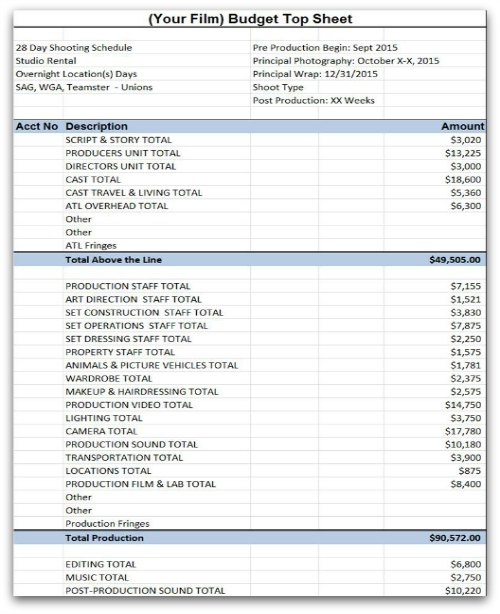
Several Budget Top Sheet templates are available online. Find the one you’re most comfortable using.
Source: Fillm Proposals

Budget Top Sheet Organizes Expenses

Filmmakers work off a Budget Top Sheet. It provides a summary of how the money is allocated during the filmmaking process.

At the top of the top sheet is the general information used in forming the budget. The names of the producer and director are listed at the top because they are responsible for overseeing the overall budget. Other information given is the start date and completion date of the production. It is imperative to understand the top sheet, as any changes to it will affect the entire budget dynamic. The top sheet will inevitably change because the production stage of a film is the most liable aspect of the process. Unknown factors, such as location, weather, actors, stunt performers, and production issues, can cause liability.

Above-The-Line vs Below-The-Line Costs

Two distinct divisions separate the budget: above-the-line and below-the-line. Based on the early days of Hollywood, the positions above the line were the more important creative elements in the production, such as screenwriters, producers, directors, and actors. Any costs relating to these categories were above the line. The below-the-line division is subdivided into the production period, the editing period, and miscellaneous overhead expenses associated with the entire production process. Obviously, a production designer, an art director, a cinematographer, a sound designer, a composer, an editor, and a costume designer are all important creative forces. Still, their costs fall below the line. It is a wise filmmaker who recognizes that everyone working on the production is an innovative resource because filmmaking is a collaborative process.

Each production has unforeseen costs.
Source: Cottonbro Studio

Above-the-line production positions recognize the four guilds that classify certain creative personnel on a project: the Screen Actors Guild, the Directors Guild, the Producers Guild and the Writers Guild. We find all the rest of the union and federation members below the line.

Adding the above-the-line costs and the total below-the-line costs presents the direct cost for the whole production. Remember, this is not the final budget, as other unforeseen costs may arise. A contingency line is added to the top sheet for those unexpected elements. The contingency is predetermined as a percentage of the overall budget. Ideally, a 10 percent contingency fee should work. However, some productions have been as high as 30 – 40 percent. A contingency fee is the requirement for procuring a completion bond. Therefore, the direct cost, the contingency fee, and the completion bond make up the total cost for production. The top sheet of the budget also includes “other fees,” such as bank interest or other indirect costs that the filmmaker may not be aware of until after the budget is finalized.

What are Deferments in Film Production?

On the top sheet of the budget, you can include deferments. This is when the filmmaker determines that the available funds for the production are insufficient to cover the talent or services. The idea of deferred payment was introduced and developed in the 1970s. The advantage of deferred payment is that one doesn’t have the money or wherewithal to pay for the talent or services. As a result, they can pay them later. The disadvantage is that the talent or service can charge interest on the deferred payment, which will cost the production more money than if they had paid them upfront, and deferred payments are added to the negative cost. Then, the filmmaker will have a reputation for exceeding the production budget. Negative cost is the expense of producing a film. It excludes such costs as distribution and promotion. An example of a sound deferment is the Directors Guild allowing producers to hire its members based on the project’s budget. If the amount is less than $6 million, they pay 70 percent of the salary to the director, while the remaining 30 percent is deferred. In the bargain, they pay an additional 25 percent to the director for agreeing to the deferment.

The filmmaker should explore all options to keep the project within its budget while maintaining creativity. Yet, the producer pays attention to innovative suggestions that deviate from the original financial plan. It’s their job to help the project stay within its financial limits.

Although a budget is created for the overall production, it serves primarily as a guidebook for making decisions within the budget’s parameters. The budget must always stay within those parameters. If it does, the filmmaker must seek additional funding to complete the project.

As the project moves into production, it will take on a life of its own. You must safeguard your creative vision while avoiding getting lost in budget misfortunes. That is where the line producer comes in and manages the overall production flow.

The Indie Producers Handbook: Creative Producing from A to Z

The Indie Producers Handbook: Creative Producing from A to Z

This is my go-to book for film production. I recommend reading The “Indie Producer’s Handbook: Creative Producing from A to Z,” written by a film producer, Myrl A. Schreibman. It delivers a comprehensive and practical guide to running a film on a budget.